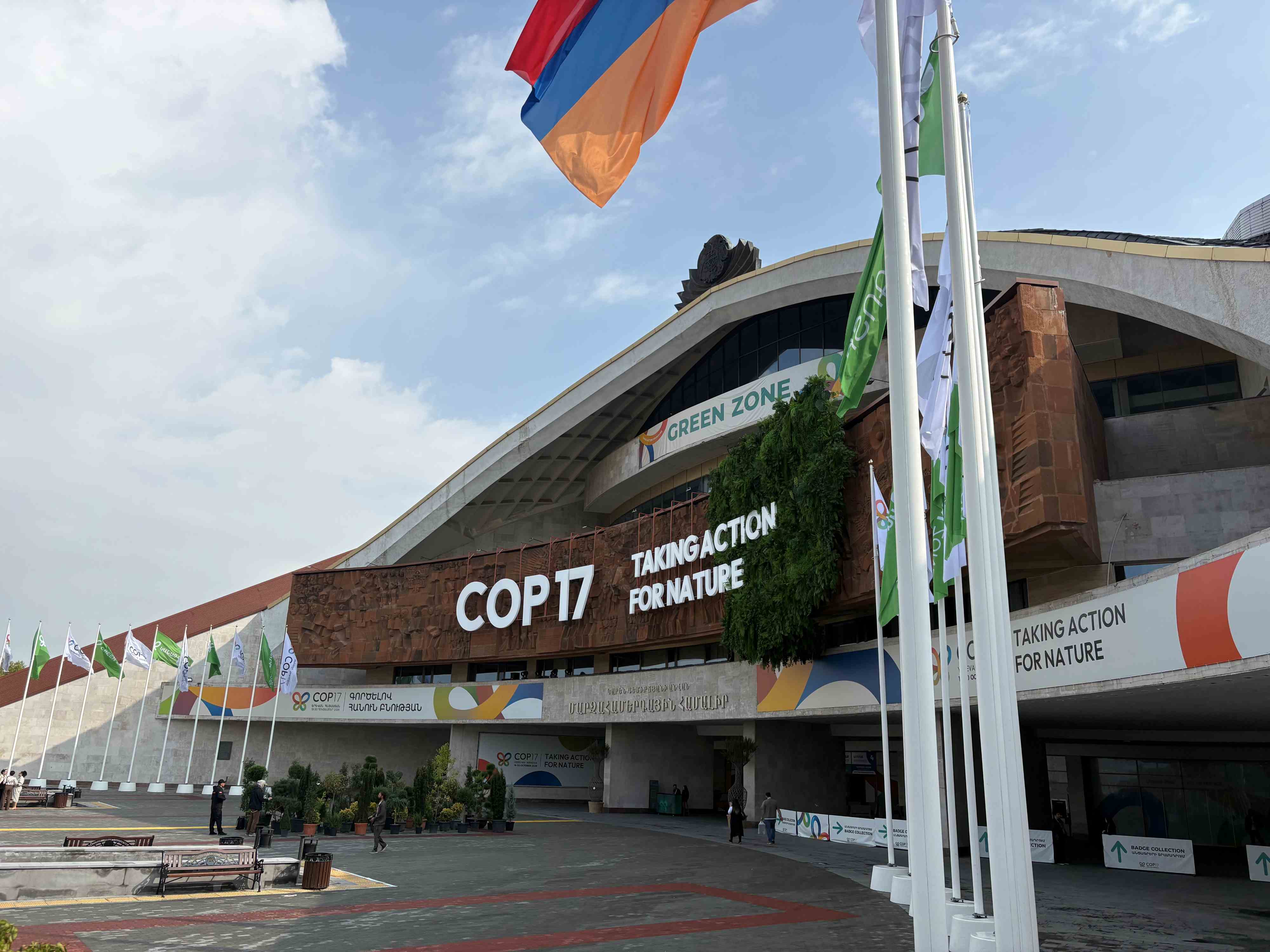
22-27 October 2026 – The United Nations Sustainable Stock Exchanges initiative (UN SSE) convened a series of events during the UN Biodiversity Conference (CBD COP17) in Yerevan, Armenia, exploring how capital markets can support implementation of the Kunming-Montreal Global Biodiversity Framework (GBF).
Across five events, discussions focused on the role of exchanges, together with regulators, investors, issuers, and financial service providers, in advancing systemic change, integrating nature into market practices, strengthening board oversight of sustainability-related information and mobilizing finance through sustainable bond markets. The events reflected the UN SSE's ongoing work with its global network of Partner Exchanges to translate international sustainability frameworks into practical market action.
Advancing systems change through central market organizations
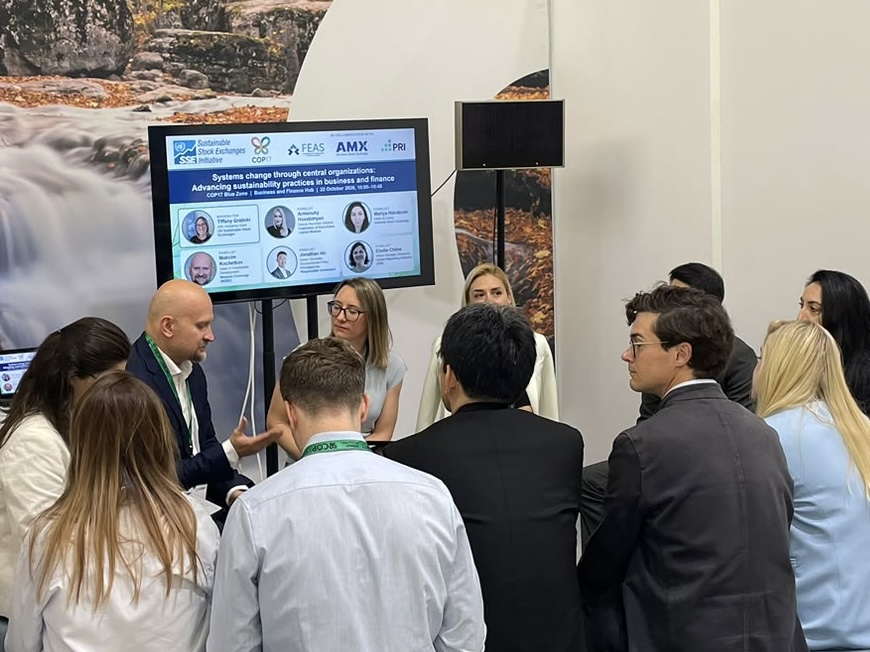
On 22 October 2026, the UN SSE convened Systems Change Through Central Organizations: Advancing Sustainability Practices in Business and Finance in the COP17 Blue Zone, in collaboration with the Federation of Euro-Asian Capital Markets (FEAS) and the Armenia Stock Exchange (AMX), with support from the Principles for Responsible Investment (PRI).
Moderated by UN SSE Academy Head Tiffany Grabski, the discussion brought together Armenuhy Hovakimyan (FEAS), Mariya Hakobyan (AMX), Maksim Kochetkov (Moscow Exchange), Jonathan Ho (PRI) and Elodie Chêne (GRI). The panel examined how central organizations in capital markets can help align financial systems with sustainability objectives, particularly those relating to nature and the GBF. Collaboration emerged as a central theme. Panelists shared examples of exchanges identifying obstacles within their markets and working with investors, issuers, regulators and central banks to develop solutions, including new financial products emerging from market-wide cooperation.
The discussion reinforced the distinctive position of stock exchanges as conveners of capital market participants. Through their relationships with listed companies, investors, intermediaries and regulators, exchanges can help build common understanding, improve transparency and support the market infrastructure needed to advance sustainability objectives. Panelists also emphasized the importance of establishing a credible business case for nature-related action, including market conditions that allow nature-related risks and opportunities to be appropriately reflected in financial decisions.
Another recurring theme was the interconnection between nature and climate, and the importance of communicating these issues in ways that resonate with different market participants. Education and capacity building were highlighted as essential foundations for progress. As Armenuhy Hovakimyan noted, effective capacity building requires a layered approach, reaching market organizations, corporate boards and the next generation of financial and business leaders.
The session highlighted the potential for exchanges and other central organizations to support implementation of GBF Targets 14, 15 and 19, including integrating biodiversity into financial decision-making, strengthening corporate transparency and mobilizing finance for nature.
Identifying ways to scale capacity building in developing markets
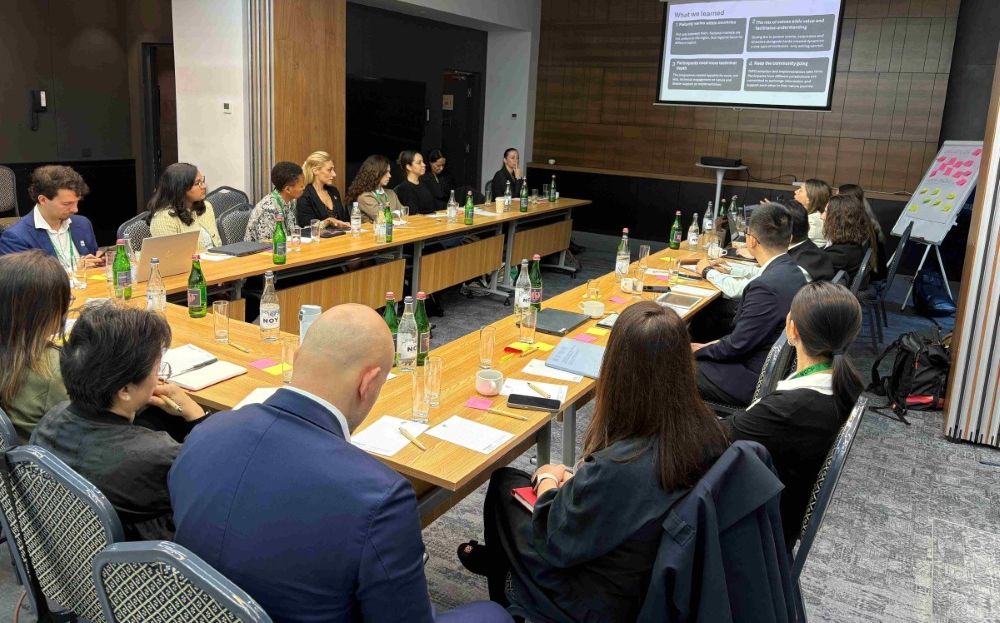
On 23 October 2026, partners delivering TNFD capacity building with support from Germany’s International Climate Initiative (IKI) met at the TNFD Hive in Yerevan, alongside COP17. The roundtable was convened by UNDP, TNFD, WWF, Global Canopy, UNEP FI, PRI, WBCSD and the UN SSE. It brought together around 30 participants, including national partners, business associations and TNFD Consultation Groups. As nature-related disclosure moves from framework design to market implementation, capacity has become the main constraint, particularly in developing and emerging markets. The session took stock of progress since 2025, compared national experiences and agreed shared priorities for the next phase.
Capacity building has reached scale, and demand keeps growing. The UN SSE’s Nature Capacity Building Programme has delivered 14 CPD-certified workshops with 10 host stock exchanges. These have reached 4,600 participants in 147 countries or territories, in English and Spanish, and over 10,000 are expected to be trained by the end of 2026. In parallel, the Nature Reporting Preparer Forum, run by UNEP FI, PRI and WBCSD, has trained over 700 professionals in 55 countries. Speakers from China, South Africa, Malaysia, Brazil, Italy and India shared national experiences. A common pattern emerged: many organisations already use LEAP or publish nature-related reports without formally registering as TNFD adopters, and those that have completed LEAP assessments are now asking what comes next.
The UN SSE drew four lessons from its programme, based on more than 300 questions asked by participants in live workshops:
- Market demand is growing. Over 1,000 people registered for global sessions open to SSE Academy alumni, and the most recent workshop, hosted by Bursa Malaysia, drew more than 900 participants.
- Connecting markets with experts matters. Questions ranged from “where do we start?” to how to embed nature risks in enterprise risk registers and board decisions.
- Companies need a clear path through the reporting landscape. How TNFD fits with IFRS S1 and S2, GRI, ESRS and local regimes came up in almost every market, often with the aim of avoiding duplicate reporting.
- Data and quantification are the hardest practical step. Participants asked how to translate nature risks into financial terms and what to do when site-level biodiversity data is thin. This concern recurs across emerging markets.
Partners agreed that the next phase must turn training into action. That means LEAP pilots on real portfolios and value chains, earlier engagement with central banks, supervisors and stock exchanges, and a focus on the whole capital chain, whose expectations drive corporate disclosure. Participants also called for shared infrastructure, such as regional data partnerships, disclosure clinics and collaboration that helps measure changed decisions. Other priorities were embedding capacity in national institutions such as universities, trainer networks and business associations, and funding to help companies in developing markets through their first disclosures.
The UN SSE’s contribution builds on its work with partner exchanges to integrate nature into markets. This includes the UN SSE–TNFD Model Guidance for stock exchanges and the exchange Action Plan, How Exchanges Can Integrate Nature Into Markets, launched at COP17. Still to come in Q4 2026 are eight more workshops, including with the Johannesburg, New York and Toronto stock exchanges, and the first workshop in Mandarin with the China Sustainable Investment Forum. A course adapted for banks will launch this year as well.
Launching an Action Plan for exchanges at the TNFD Hive
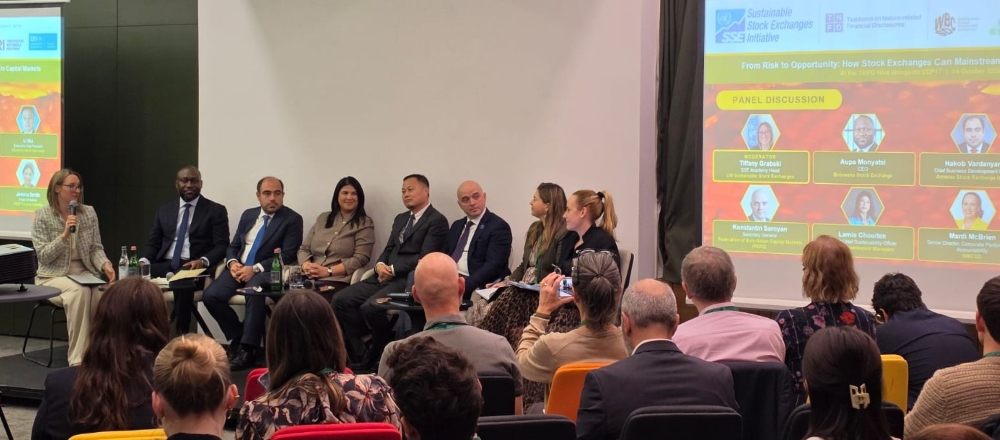
On 24 October, the UN SSE and TNFD, together with WBCSD, PRI and UNEP FI, hosted From Risk to Opportunity: How Stock Exchanges Can Mainstream Nature in Capital Markets as part of the TNFD Hive programme alongside COP17. The event marked the launch of the SSE's new Action Plan, How Exchanges Can Integrate Nature Into Markets, which offers exchanges and regulators a flexible menu of actions across four areas: Establish, Activate, Enable and Educate.
The event was kicked off with opening remarks from Tony Goldner, CEO of TNFD, and a powerful keynote by Aupa Monyatsi, CEO of the Botswana Stock Exchange and Co-Chair of the UN SSE Advisory Group on Nature. This was followed by a panel of exchange leaders, investors, companies and international organizations discussed how exchanges are already integrating nature and what more can be done. Sue Lloyd, Vice-Chair of the ISSB, closed the session with a call for all stock exchanges to make use of the new publication alongside the newly released ISSB Practice Statement on Nature now out for consultation.
Read more about the launch of the Action Plan and the event here.
Strengthening board oversight of nature and sustainability information
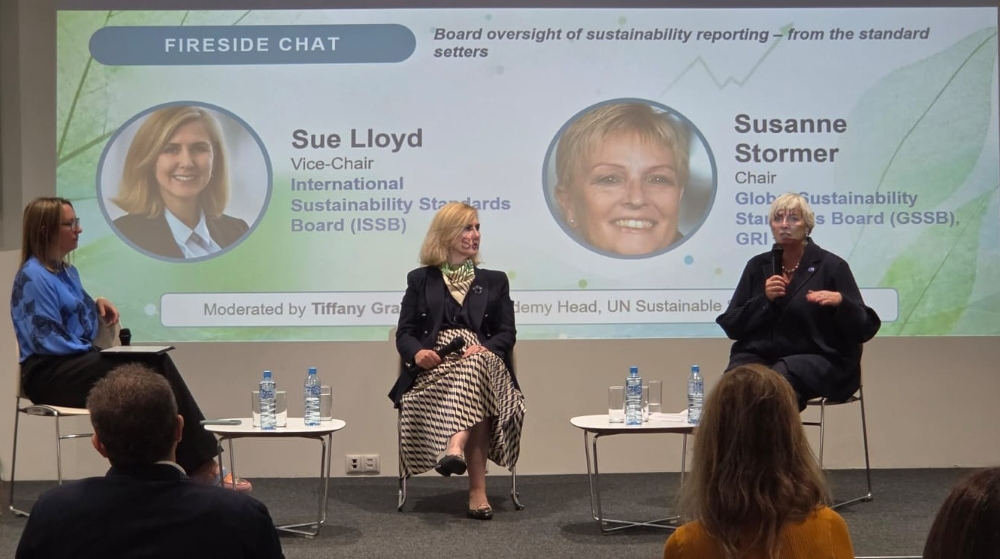
On 27 October 2026, the UN SSE and the Armenian Institute of Directors co-hosted From Disclosure to Decision: Board Oversight of Information on Nature and Sustainability, bringing together international standard setters, board directors and sustainability experts in Yerevan.
The session examined the growing responsibility of corporate boards to oversee sustainability-related information and ensure that disclosures inform strategy, governance and risk management. With nature-related risks and opportunities receiving increasing attention from investors, regulators and standard setters, the discussion focused on how boards can strengthen their capabilities to understand and oversee sustainability-related information, including the implications of corporate dependencies and impacts on nature.
The session opened with a fireside chat between Sue Lloyd, Vice-Chair of the International Sustainability Standards Board (ISSB), and Susanne Stormer, Chair of the Global Sustainability Standards Board (GSSB) at the Global Reporting Initiative (GRI), moderated by Tiffany Grabski, Head of the SSE Academy. It was the only event at COP17 where GRI and ISSB shared the stage to focus specifically on how their two sets of standards align and work together. The discussion took place as the ISSB consults on its proposals for nature-related disclosures. Sue and Susanne discussed practical ways to help companies that choose or need to apply both sets of standards, reflecting the commitment of the IFRS Foundation and GRI to support greater clarity and efficiency for organizations applying both.
“The ISSB’s draft Practice Statement on nature-related disclosures is a welcome complement to GRI’s well-established standards for impact reporting on nature. With stronger reporting on nature-related financial risks and opportunities for businesses, we can expect to see more transparent corporate disclosures, which in turn facilitate better-informed decision-making. That’s the goal we share,” said Susanne Stormer.
“In developing our proposals, the ISSB has explored how we can best enable companies to apply ISSB nature-related disclosure requirements and GRI Standards without duplicating efforts. Our goal is to minimise complexity where possible,” said Sue Lloyd.
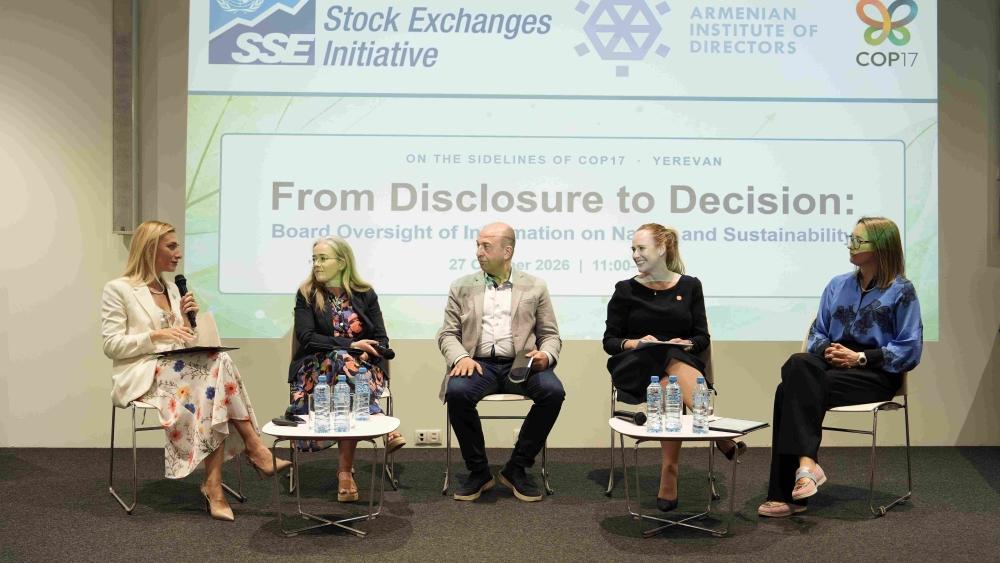
The fireside chat was followed by a panel moderated by Armenuhy Hovakimyan, CEO of the Armenian Institute of Directors, with Candice Dott, Director of Market Engagement at TNFD; Mardi McBrien, Senior Director, Corporate Performance & Accountability at WBCSD; Arsen Nazaryan, Partner and Head of Advisory Services at Nexia Armenia; and Tiffany Grabski Academy Head at the UN SSE. The panel dove into the technical details of what effective board oversight of nature and sustainability information requires in practice.
Panelists highlighted capacity building as a priority and pointed to the need for additional guidance developed specifically for boards, to help directors understand what questions to ask, how to interpret nature-related information and how to embed it in their oversight of strategy and risk.
The event connected developments in global sustainability reporting with the practical responsibilities of board directors. In particular, it explored the importance of moving beyond disclosure as a compliance exercise toward using sustainability-related information to support informed oversight and long-term decision-making.
The session also reflected the UN SSE's wider work to strengthen board-level understanding of sustainability issues, including through the SSE Academy's training programmes for corporate directors.
Financing a greener future: Sustainable bonds in Armenia and the region
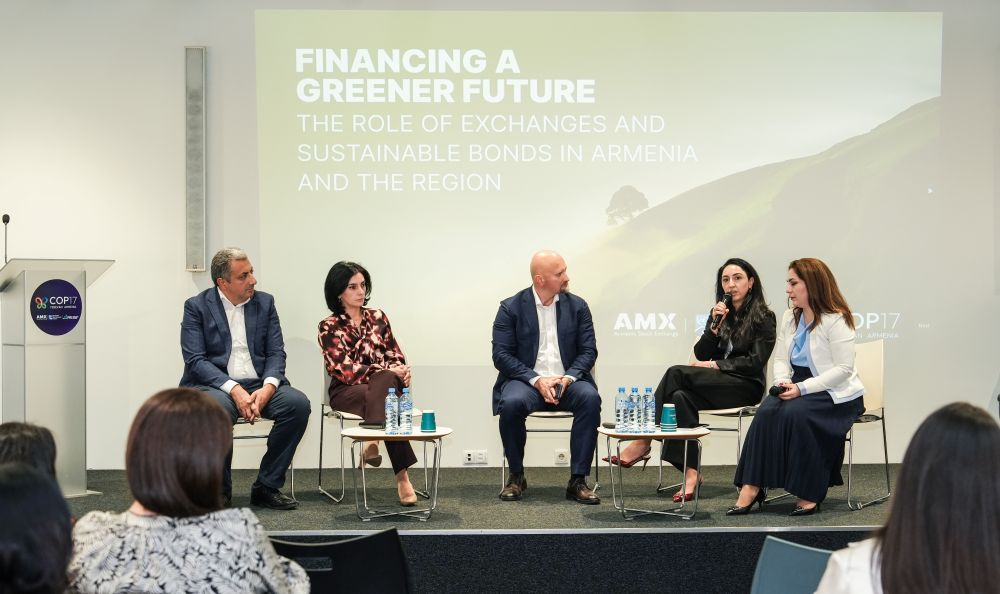
Also on 27 October 2026, the UN SSE and Armenia Stock Exchange (AMX), with support from PRI, convened Financing a Greener Future: The Role of Exchanges and Sustainable Bonds in Armenia and the Region. The event brought together representatives of capital markets, government institutions, international organizations and the financial sector to discuss opportunities for financing nature conservation initiatives, promoting sustainable investment and developing bond markets across the region.
Welcoming remarks were delivered by Hayk Arakelyan, Deputy Minister of Environment of the Republic of Armenia, and Hakob Vardanyan, Chief Business Development Officer at AMX. Mr Vardanyan emphasized that stock exchanges are not merely platforms for securities trading but key institutions that connect capital with investment opportunities and encourage long-term investment. He also highlighted the potential of green and sustainability bonds to finance projects with positive environmental impacts, and the importance of cooperation among government institutions, financial institutions, investors and international partners.
Jan Amrit Poser, Co-Founder of the Nature Bonds Initiative, delivered a keynote presentation on the outlook for nature-related bonds and their potential applications, global trends in sustainable finance, the assessment of biodiversity-related risks in investment decision-making, and the role of capital markets in financing environmental projects.
The panel discussion, moderated by Ligia Ghazaryan, Executive Director of the Agricultural Insurers’ National Agency (AINA), brought together Mariya Hakobyan, Head of the Listing Department at AMX; Ashot Petrosyan, Head of the Financial System Development Department at the Central Bank of Armenia; Shushanik Hovsepyan, Head of Capital Markets and Investment Banking at Ameriabank; and Maksim Kochetkov, Head of Sustainable Development at the Moscow Exchange (MOEX).
The discussion explored the interconnection between nature conservation and capital markets, the prospects for developing financial instruments that support environmental objectives, and opportunities to mobilize investment through green and sustainability bonds. Panelists also emphasized the importance of strengthening regional cooperation to make the most of capital markets in achieving sustainable development goals. The regional conversation was then put into the global context with a presentation by Balckrock's Cherry Muijsson, Chief Investment Officer, Multi Asset Strategies and Solutions.
In her closing remarks, Tiffany Grabski, Head of the UN SSE Academy, summarized the key themes and emphasized the importance of international cooperation and knowledge-sharing in advancing sustainable finance. The event underscored the role of capital markets in aligning environmental priorities with investment opportunities in Armenia and across the region.
In summary - from global commitments to practical market action
Together, the five events highlighted the interconnected roles of market infrastructure, corporate governance and financial innovation in advancing nature-related action.
Stock exchanges occupy a unique position at the centre of capital markets. Through their listing rules, disclosure guidance, market segments, products and capacity-building programmes, they can help companies and investors respond to emerging sustainability expectations while supporting national development priorities.
At the centre of the UN SSE's COP17 engagement was the launch, with TNFD and partners, of How Exchanges Can Integrate Nature Into Markets, giving exchanges and regulators a practical roadmap for integrating nature-related considerations into market practices.
As countries work to implement the Kunming-Montreal Global Biodiversity Framework, the SSE's engagement at COP17 underscored the importance of collaboration between international organizations, national institutions and market participants to translate global objectives into practical action across capital markets.
Through its global network and the SSE Academy, the UN SSE continues to support exchanges in strengthening market transparency, building capacity and mobilizing finance for sustainable development. In the past twelve months, the SSE Academy has trained over 4,600 market participants on the TNFD’s recommendations on nature-related assessment, management and disclosure, in collaboration with SSE partner exchanges.
If your organisation would like to partner with the SSE to promote sustainable development through capital markets, contact us here. To stay informed about future training sessions, events or other SSE-related news subscribe to the SSE mailing list.