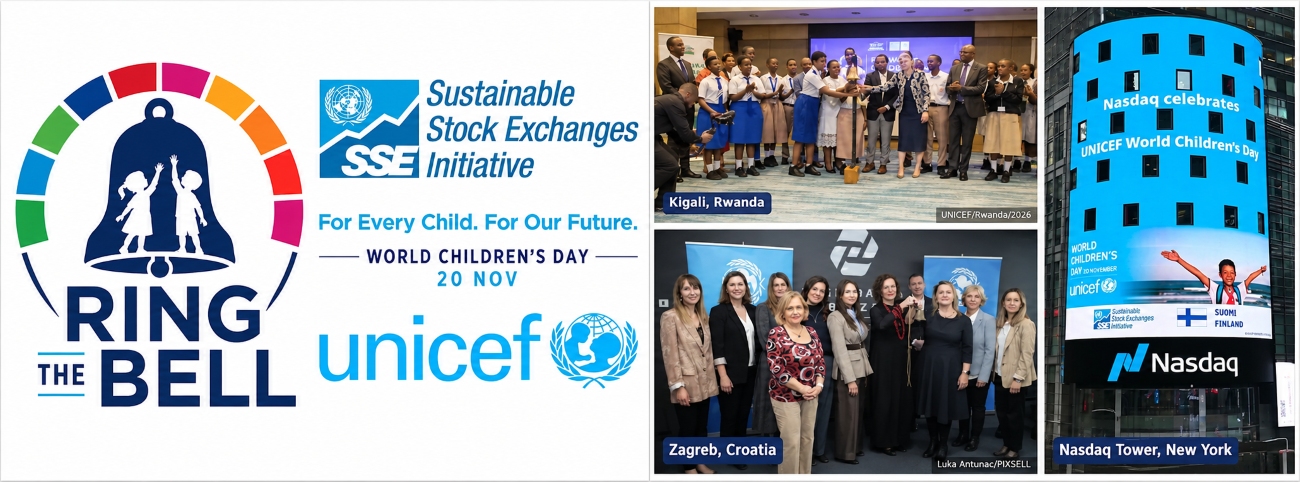
For the first time, more than 20 stock exchanges representing nearly 30 markets have come together to Ring the Bell for World Children's Day, highlighting the important role capital markets can play in advancing children's rights and well-being. Exchanges, together with UNICEF local offices and other key stakeholders, mobilized market participants through opening and closing bell ceremonies, high-level discussions and awareness-raising activities.
The global campaign, led by the United Nations Sustainable Stock Exchanges (UN SSE) initiative in collaboration with UNICEF, coincided with the launch of new resources for market participants, high-level events in New York and Geneva, and the announcement of forthcoming training through the SSE Academy.
Almost one in five children globally lives in extreme poverty, and nearly 417 million lack access to basic necessities such as food, sanitation, shelter, healthcare and education. This has implications for economic growth and market resilience. Companies and investors are uniquely positioned to help address these challenges while unlocking unrealized financial value. This global mobilization calls on companies and investors to consider children as a distinct stakeholder group, recognising that children are central to the health and sustainability of economies, markets and societies. They represent the future workforce, consumers, innovators and leaders.
Through its collaboration with UNICEF, the UN SSE initiative is equipping market participants with the knowledge, tools and resources to integrate child-related considerations into business and investment practices.
Advancing Child-Lens Investing in Capital Markets: New York
On 20 November, World Children's Day, the UN SSE initiative, together with UNICEF and UNICEF USA, convened a high-level roundtable focused on Advancing Child-Lens Investing in Capital Markets at Nasdaq Headquarters in New York.
UNICEF Executive Director Catherine Russell delivered opening remarks, highlighting the importance of children's rights and well-being to sustainable economic development and long-term prosperity.
“Every child deserves to be healthy, educated and protected,” said Catherine Russell, UNICEF Executive Director. “Businesses and investors have played a key role in making that possible. In today’s changing world, hard-won gains for children are at risk.
As UNICEF approaches its 80th anniversary, World Children’s Day is a pivotal moment to put children’s rights and well-being at the heart of every investment decision–to build stronger communities, economies and a better future for generations to come.”
The roundtable also featured senior leaders from the investment community, government, academia and business, as well as a youth representative.
“Investing in a sustainable future means recognizing the importance of the next generation,” said Cambria Allen-Ratzlaff, Interim CEO, Principles for Responsible Investment (PRI) and UN SSE Governing Board Member. “Children’s rights and well-being are closely connected to the health of our economies and societies. As investors increasingly consider the factors that shape long-term value, initiatives like this help bring greater attention to the role capital markets can play in supporting a more resilient and prosperous future.”
Participants explored opportunities to accelerate the adoption of Child-lens Investing, recognizing both the responsibility of companies and investors to respect children's rights and the risks and opportunities associated with children's well-being.
Business and Human Rights: Geneva
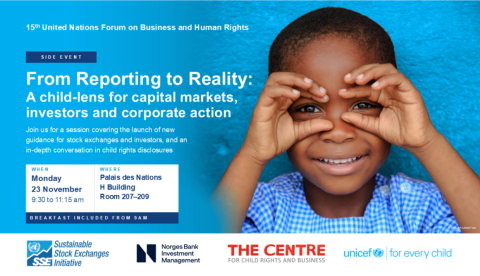
As part of the World Children's Day activities, the UN SSE, UNICEF, Norges Bank Investment Management (NBIM) and The Centre for Child Rights and Business convened a side event at the 15th UN Forum on Business and Human Rights at the Palais des Nations in Geneva.
The event, From Reporting to Reality – A Child-Lens for Capital Markets, Investors and Corporate Action, brought together investors, stock exchanges, companies and child rights experts to explore how capital markets can translate disclosure and commitments on children's rights into meaningful action. Alongside showcasing newly launched resources, discussions explored the role of stock exchanges in advancing corporate disclosure on children's rights, investors' information needs, and opportunities to strengthen human rights due diligence and reporting.
Launch of New UN SSE Resources on Child-Lens Investing
Following 12 months of collaboration with an Advisory Group made up of 46 experts from over 30 countries and chaired by the CEO of the Mexican stock exchange BIVA, the UN SSE Model Guidance on Applying Child-Lens Investing for Issuers and Investors, developed in collaboration with UNICEF, was released on 20 November 2026.
Drawing on existing international standards, frameworks and market practices, the guidance provides a practical framework for stock exchanges to support companies and investors in systematically integrating child-related considerations into their decision-making and identifying, assessing and addressing impacts, dependencies, risks and opportunities that may be overlooked through conventional business and financial analysis.
“This model guidance is an important milestone in the mainstreaming of child-lens investing as an investment practice,” said Cristina Shapiro, Chief Strategy Officer at UNICEF USA and President, Impact Fund for Children & UNICEF Bridge Fund. “The more investors and issuers that apply a child lens to their decision-making, the more those decisions will lead to positive, child-specific outcomes that ensure children around the world have an opportunity to live safe, healthy, and productive lives.”
Child-Lens Investing recognizes a two-way relationship: business activities affect children's lives through products, services, workplaces, supply chains and communities, while children's well-being influences future workforce productivity, present and future consumer demand, economic stability and long-term business performance.
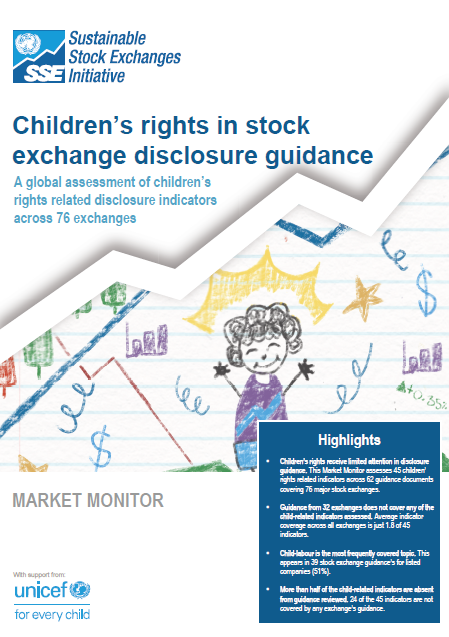
As a complementary resource for exchanges, the UN SSE Market Monitor on Child-Lens Investing provides a short, data centric, global assessment of children’s rights-related disclosure indicators across 76 exchanges disclosure guidance. Currently children’s rights receive limited attention in exchanges’ disclosure guidance. Guidance from 32 exchanges covers none of the indicators assessed. Average indicator coverage across all exchanges is less than two of 45 indicators, with only six exchanges covering five or more.
Building Market Capacity through the SSE Academy
To support the implementation of the new Model Guidance, the UN SSE initiative and UNICEF are launching a series of free training programmes on Child-Lens Investing through the SSE Academy. The first pilot training sessions, on 15 December, will equip market participants with the knowledge and practical tools to better understand the relevance of children's rights and well-being to business and investment decisions and systematically integrate child-related considerations into existing practices. Market participants are invited to learn more and register for the upcoming pilot training sessions.
From Awareness to Action
The inaugural campaign and accompanying resources represent an opportunity to address this existing market blind spot and accelerate collective action to support children today and future generations.
“Through our work this past year, we have come to see that children are often overlooked in the decisions that shape business and investment decisions, yet their well-being is fundamental to the strength of markets” said Danielle Chesebrough, Senior Specialist, UN SSE. “This work is about making those connections visible and actionable. By equipping markets with practical tools to integrate a child-lens into business and investment decisions, we can unlock overlooked value, improve outcomes for children and strengthen economies and societies for generations to come.”