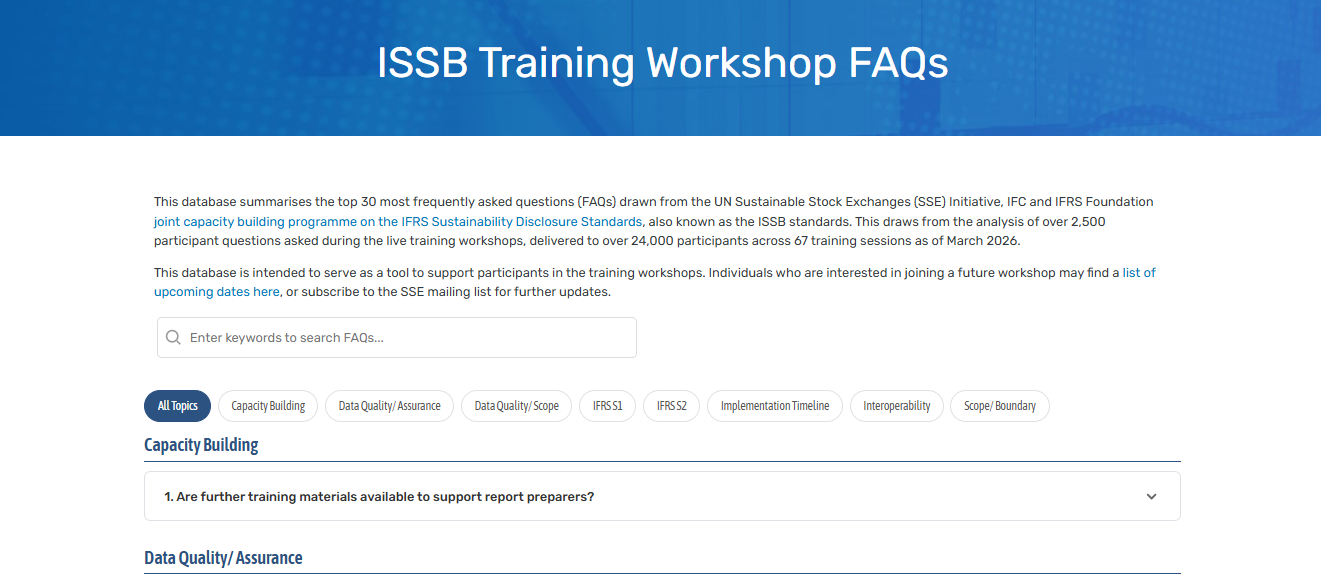
Today the UN SSE, with IFC and IFRS support, launches a new online database of frequently asked questions from its joint capacity building programme with the IFRS Foundation and the International Finance Corporation (IFC). The joint capacity building programme leverages the global reach of the UN SSE’s network of stock exchanges, the IFC’s local offices and local expertise, and the IFRS Foundation’s authoritative knowledge of its standards, to training more than 20,000 market participants globally.
As of 31 March 2026, UN SSE and its partners have conducted 67 training sessions, representing 233 hours of live training reaching 24,000 participants through the SSE Academy. Training sessions have been held in collaboration with SSE Partner Exchanges as well as with regional exchange associations, accounting and banking groups and regulators.
A key feature of the training workshops is the opportunity for participants to ask live questions and receive answers from the experts. The SSE has collected more than 2,500 questions in these workshops and has assessed them to identify frequently asked questions. These questions provide a unique insight into the key issues requiring further capacity-building support and help to identify specific knowledge gaps in the market. This new database presents an overview of the 30 most asked questions and their answers, broken down into six main categories to show the types of questions received.
The ISSB FAQ database distills more than 2,500 live questions gathered from ISSB training workshops held by the UN SSE, in partnership with IFC and the IFRS Foundation between 2023 and 2025. By transforming these recurring, practical questions into an accessible online resource, we can help companies and regulators understand what decision‑useful sustainability disclosures look like in practice, which is especially important for emerging markets. IFC is pleased to collaborate with the UN SSE on this valuable tool to support consistent, high‑quality implementation of the ISSB Standards.” — Charles (Chuck) Canfield, Corporate Governance Manager, International Finance Corporation (IFC)
Most commonly asked question types globally
Globally, the dominant question types are focused on the practical and technical application of the standards. Overall, the most commonly asked question types, in order of frequency, are:
- Scope/boundary determination (22%): Which entities (subsidiaries, joint ventures) and which assets should be included in the reporting perimeter (e.g., value chain activities, or the specific challenges of capturing Scope 3 supplier data).
- Implementation timeline & phase-in (20%): The specifics of when mandatory reporting begins, jurisdictional phase-in periods, and transition relief options, including the “climate-first” relief, and “undue cost or effort” exemption.
- Data quality, assurance and audit (18%): Questions on ensuring data reliability, the necessity of obtaining third-party assurance, and preparing internal controls for audit scrutiny.
- Climate-specifics (15%): Deep-dive questions on scenario analysis requirements, physical and transition risk identification, and greenhouse gas measurement and reporting metrics.
- Interoperability & alignment (12%): How to reconcile ISSB reporting with other major frameworks like ESRS, GRI, and the transition to IFRS S2 from existing TCFD disclosures.
- Other (13%): General sustainability reporting concepts, capacity building/training resources and queries relating to sector-specific guidance or resources.
Trends in question type across markets
When comparing the questions asked across markets, questions were found to be highly consistent in type globally, with all markets asking questions across the same top categories, but vary in priority and granularity by market. The consistency in question categories globally suggests that report preparers across markets are typically experiencing similar implementation challenges.
In markets where sustainability-related disclosure requirements were not yet mandatory or very newly introduced, questions more commonly focused on foundational concepts, such as “when to report” (for example the implementation timeline for mandatory reporting requirements in their jurisdiction), and “what to disclose” (for example, what the scope and boundary of data collection and reporting should be). By comparison, questions in markets with a longer history of mandatory requirements for sustainability-related financial information, tended to be longer and more technical. Questions were typically focused on "how to do it well," concerned with the technical rigour, auditability, interoperability between the ISSB standards and other reporting requirements (including GRI, ESRS and TCFD), and specific techniques such as measuring financed emissions.
One notable standout in the analysis was the universal “pain point” of Scope 3 emissions reporting. Similar questions on Scope 3 emissions were identified across all markets. The high degree of commonality in questions across markets reinforces the value of global capacity building initiatives, such as the UN SSE training programme, to promote consistency and address these common knowledge gaps.
Change in question type over time
A comparison of question types over time shows a clear progression in their depth and complexity. While early attendees of the workshops held in 2023-2024 were often uncertain about the extent to which the standards would need to be applied and the timelines for this, more recent attendees over 2025 were typically anticipating, or had already experienced, mandatory adoption of the standards in their markets. As a result, they were more focused on implementation and alignment of their processes in preparation for disclosure. This trend is likely to be explained by the ongoing jurisdictional adoption process, with 40 jurisdictions having adopted or used the ISSB standards as of March 2026. The increase in question granularity and technical focus over time indicates growing maturity among participants joining the training workshops.
It is encouraging to note that feedback on the UN SSE training sessions has remained strongly positive over this time period, with a consistent 95% average satisfaction rate reported by participants over 2023-2025. This indicates that the adaptations made to the training over time, to reflect both developments in reporting guidance and practice, and respond to participant feedback, ensure that the training sessions continue to offer a highly valuable capacity building opportunity for participants.
For more information about the training programmes offered, refer to the SSE Academy, or subscribe to the SSE mailing list.
This database was developed with the support of the Swiss State Secretariat for Economic Affairs (SECO).